A glimpse into the creative process of Charles Maring, where photography, filmmaking, music, emerging technology, and human collaboration come together to turn imagination into meaningful visual stories.
Sometimes I am hired to make the film. Sometimes I am hired to help figure out what the film should be.
I have spent my career moving between photography, filmmaking, music, art, storytelling and creative direction, working with people and companies across remarkably different industries. The medium changes. The technology changes. The challenge changes. What remains is the need for an idea worth communicating and a reason for someone to care.
My role is often somewhere between creative director and filmmaker. I can enter a project early, help find the story or concept, develop the visual language, and then create many of the assets needed to bring that idea to life.
That might mean a camera and a real person telling an authentic story. It might mean actors, lighting and a carefully directed production. It might involve animation, original music, photography, artificial intelligence or a combination of all of them.
The tools are chosen for the idea, not the other way around.
Creative Direction & Film
Ideas are where the work begins.
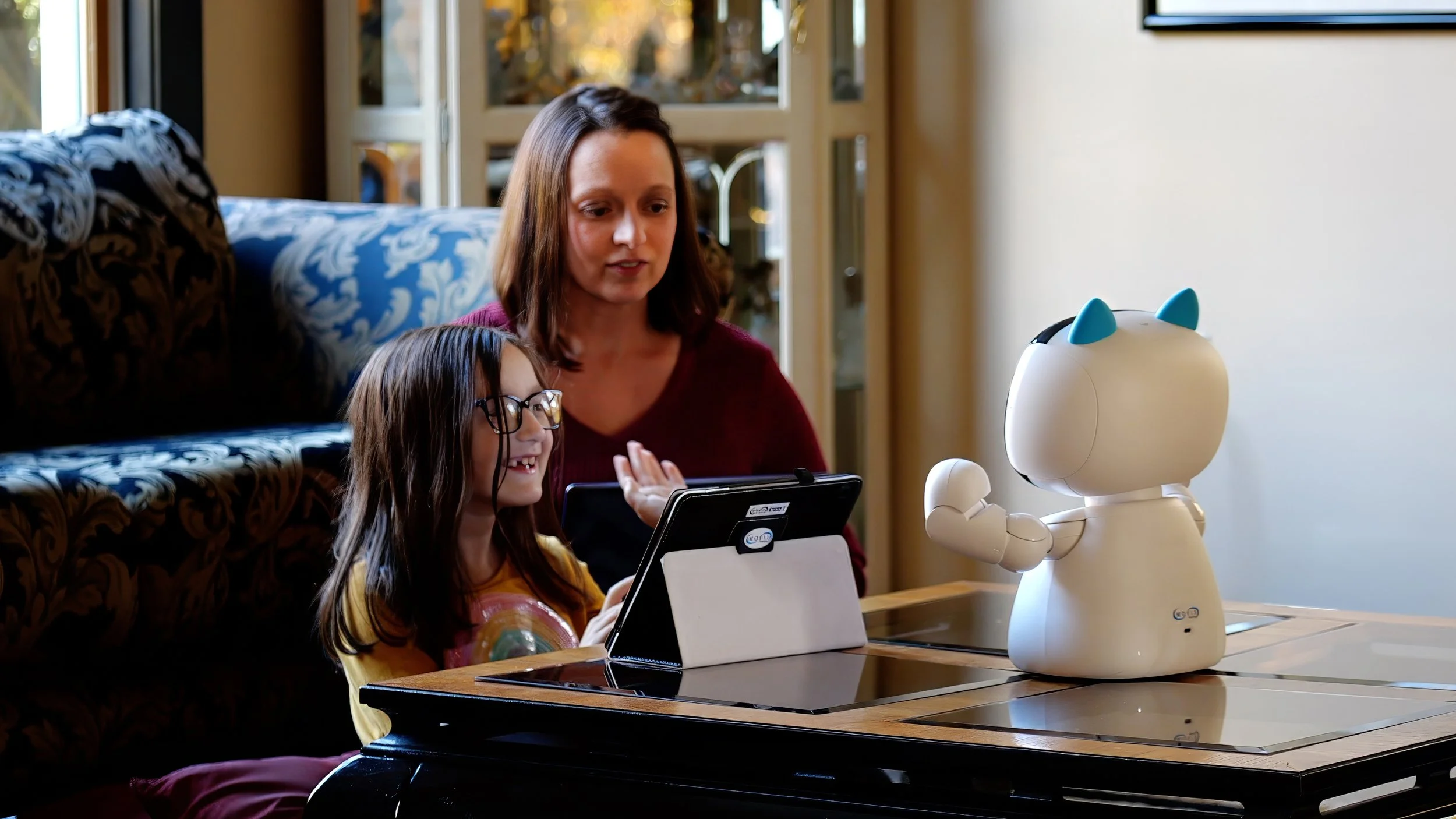
Real families. Real environments. Real experiences. Documentary storytelling for MOVIA Robotics.
Making technology human
I was once hired to humanize a robot.
A robotics company developed technology designed to help children on the autism spectrum with learning, communication and everyday routines. To understand that story, I couldn't simply photograph the product.
I needed to understand the people around it.
That meant filming inside the robotics lab at UConn where the vision was being developed. It meant entering schools and people's homes. It meant listening to scientists, educators and families. It meant documenting authentic experiences while also creating narrative films that could make complicated ideas understandable.
The technology was fascinating. But the technology wasn't really the story.
The people it could help were.
The work eventually expanded into narrative films demonstrating how the technology could become part of ordinary life. A robot could patiently encourage a child through a repetitive task such as brushing their teeth. It could participate in learning. It could even tell a bedtime story.
The challenge wasn't to make the robot more impressive. It was to make the technology more meaningful.
HomePal Encourages. A narrative film exploring how technology can support the everyday routines of a child.
That experience left me with an idea that has only become more relevant as technology has accelerated:
Human First doesn't mean using less technology. It means never losing sight of who the technology is for.
Finding the idea
Not every project begins with a story that already exists.
Sometimes the assignment begins with a product, an unexpected thought, a bit of humor or simply the question: What if?
That's where I love to work.
An idea doesn't have to be complicated to be memorable. Sometimes the most interesting creative direction comes from taking something familiar and looking at it differently. The challenge is finding the right visual language, rhythm and personality to make the concept work.
Ideas can be funny, cinematic, strange, beautiful or deliberately unexpected. What matters is whether the finished work gives someone a reason to stop, watch and remember.
Technology has made it easier than ever to make more things. It hasn't made it easier to know which things are worth making.
That's where taste and judgment matter.
Imagining what doesn't exist yet
Some ideas begin without a set, a cast or even a physical world to photograph.
Emerging creative tools have dramatically expanded what one person can visualize. I use them much the way I use a camera, lighting, music, or an editing suite: as another set of instruments available to the idea.
A speculative brand film beginning with an original product photograph and expanding into an imagined world of sunflowers, bees and honey.
Thousands of possibilities don't necessarily make the work easier. They create thousands of decisions.
What belongs? What doesn't? When is something beautiful but wrong? When is a joke too much? When does an image finally feel believable? When should technology disappear completely and a real camera come out?
AI can generate possibilities.
It cannot tell me which ones matter.
When Humor Becomes the Creative Direction
For this speculative beef jerky campaign, I imagined Santa Claus as a character with a little more attitude, personality and appetite than the familiar holiday icon. The concept combined humor, character development, storytelling and AI assisted filmmaking to create something playful and memorable.
Finding the right Santa was part of the creative process. I explored and rejected countless variations before arriving at a character with the right expression, personality and comedic presence. I even recorded my own voice performance before experimenting with AI voice casting to find the right delivery.
The technology made the production possible. But the humor, timing, character choices and countless creative decisions were human.
The ability to generate a thousand Santas doesn't mean you've found the right one. That's where taste and judgment come in.
A holiday campaign for a sustainable beef jerky brand. Concept, creative direction, character development, voice performance and AI assisted filmmaking by Charles Maring.
When the idea crosses mediums
Sometimes a project doesn't fit neatly into one discipline.
Island Time. An original song expanded through music, filmmaking, visual storytelling and an imagined world created around it.
I wrote and performed Island Time before there was a visual world around it. The film became another way of extending the idea.
That same instinct runs through much of my work. A photograph can become a film. A painting can become animation. Music can establish the emotional architecture of a story. A real-world production can begin with artificial intelligence as a way to visualize an idea before anyone steps onto a set.
I don't see these as separate disciplines.
They are different ways of communicating.
From imagination back to reality
Technology can also help make traditional production better.
When developing a music film for Delta Circle, I could explore visual ideas and storyboard possibilities with AI prior to production giving the band confidence and clarity about how I envisioned the treatment and scenes. But eventually we loaded cameras, lighting and equipment into the car, met the band, filmed in a Savannah bar, headed into a field, launched a drone and kept shooting as daylight disappeared.
Delta Circle. AI-assisted previsualization developed into an authentic live-action production in Savannah.
Clear Vision. More Room to Be Human.
Something else happened during that process that no storyboard could have predicted.
We laughed. We experimented. We listened to one another's ideas. Trust developed, and the collaboration itself became part of the creative process.
Because we arrived with a clear vision and a well-organized plan, we had the freedom to explore. We could follow an unexpected idea, try something spontaneous, or recognize a moment worth capturing that wasn't in the original storyboard.
The preparation didn't limit our creativity. It gave us more room for it.
Technology helped us imagine what was possible.
People made it meaningful.
One vision. Many ways to bring it to life.
I don't think of photography, filmmaking, music, artificial intelligence, writing, or art as separate boxes.
They are tools.
The advantage of working across them is continuity. An idea doesn't necessarily have to travel from creative director to agency to production company to photographer to filmmaker to editor before becoming real. I can often stay with an idea from its earliest stages through its execution, bringing in the right collaborators when the project calls for them. For companies with internal marketing teams or agency partners, my role isn't to replace those people. I create the concepts, stories and digital assets they can put to work. And when that relationship continues over time, something even more valuable happens. The stories begin connecting.
A founder's story overlaps with a customer story. A product film connects with a testimonial. Photography establishes a visual language that reappears in another campaign. One piece gives context to the next. Eventually, it isn't a collection of content.
It becomes a body of work.
Bring me the idea. Or bring me the problem.
You don't need to know whether the answer is a film, a photograph, an interview, animation, music, artificial intelligence or something we haven't considered yet.
That's part of the work.
If you have a story worth telling, a product worth understanding, or simply an interesting problem that needs a creative point of view, I'd like to hear about it.