Preserving 90 Years of Faith: The Art of Church History Documentary Filmmaking
Every church has a history, but much of that history lives in places that are easy to overlook. It lives in aging photographs, handwritten records, recordings from another era, and the memories of people who have spent decades worshiping, serving, and raising their families within a congregation. Over time, those memories become part of a community's identity, connecting generations through shared experiences, traditions, and faith. Yet history can be surprisingly fragile. Photographs deteriorate, recordings become difficult to play, and the people who remember the earliest chapters eventually pass away. What remains is often a collection of fragments, each holding a small piece of a much larger story that deserves to be preserved.
When I was invited to direct and produce a documentary celebrating the 90th anniversary of South Gastonia Church of God in Gastonia, North Carolina, I saw an opportunity to bring those fragments together. Founded in 1933, the church had accumulated nine decades of history, and the challenge was not simply to organize photographs and interviews into a commemorative film. It was to discover what mattered most, preserve the voices of people who had lived that history, and create something meaningful for the generations who would follow. As a photographer, filmmaker, musician, and visual artist, I have always been interested in the relationship between memory and storytelling. This project reflects the approach I bring to creative direction and filmmaking, where technical experience, visual artistry, and human storytelling come together to create something meaningful.
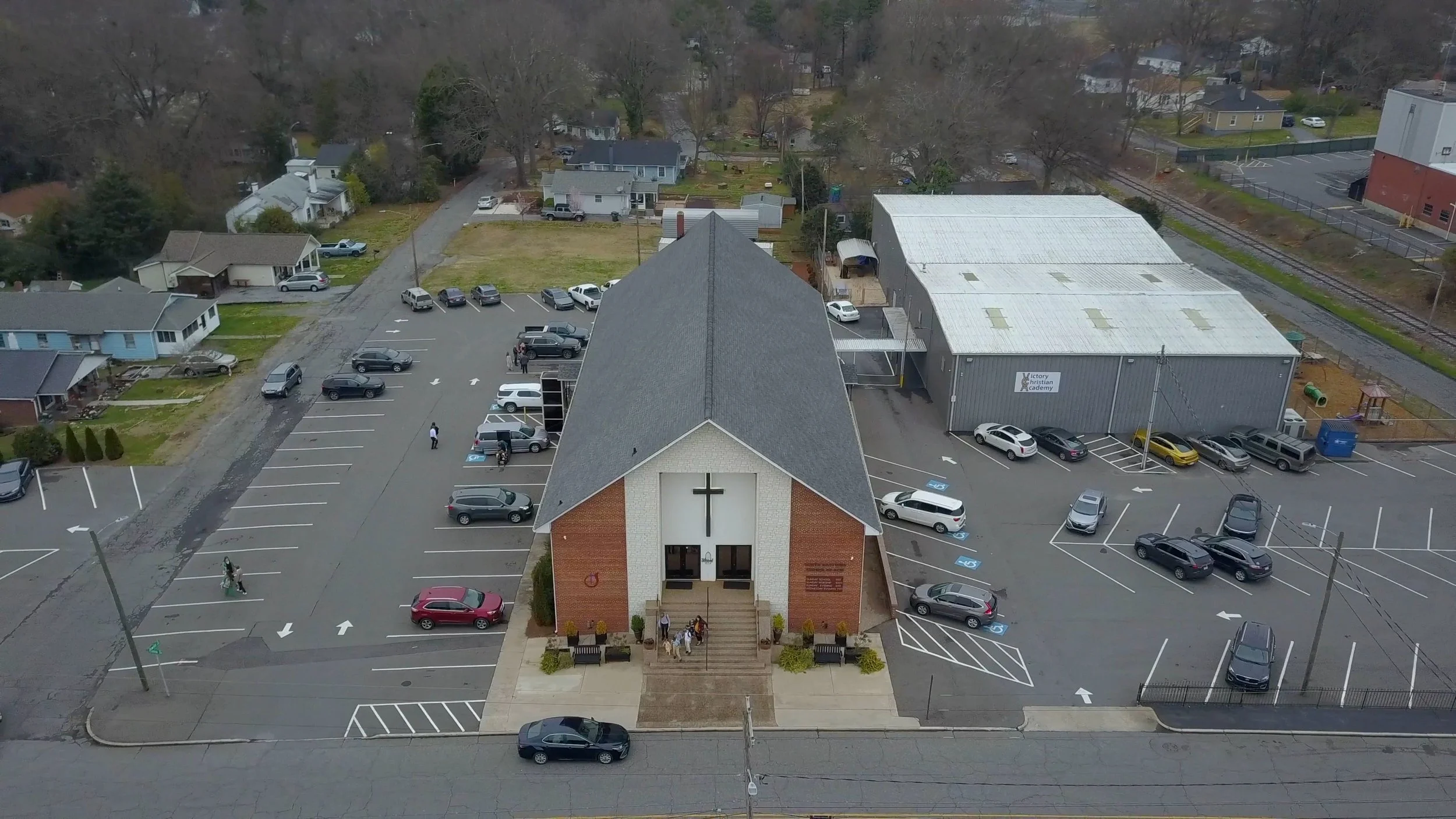
A contemporary aerial view of South Gastonia Church of God, connecting the congregation's 90-year history with the place it calls home today.
A Church Is More Than a Building
The history of a church cannot be reduced to a timeline of buildings, pastors, and important dates. Those details matter, of course, but they are only part of the picture. A church is a community of people whose lives intersect over generations. Its story is shaped by the individuals who established it, the families who sustained it, the ministers who led it, and the countless people who found belonging within its walls. As I began exploring South Gastonia's history, I became increasingly interested in the relationship between the congregation's earliest members and the people who continue that legacy today. The church had changed over the decades, but the photographs and personal recollections revealed a remarkable continuity of faith and community.
One of the historical photographs I worked with showed the congregation gathered outside the church in 1940. Looking at those faces, I found myself wondering about the lives represented in that single frame. Some were undoubtedly parents and grandparents. Others were children whose lives were only beginning. Each person had a story, and together they represented a community that would continue evolving long after the photograph was taken. That is what makes historical documentary filmmaking so interesting to me. A photograph preserves a moment, but a documentary can begin to explore what that moment meant, how the people within it influenced one another, and how their lives continue to resonate through the generations that followed.

The congregation of South Gastonia Church of God in 1940. Historical photographs like this became important visual connections between the church's earliest generations and its present-day community.
Finding the Story Before Turning on the Camera
One of the most important parts of directing a historical documentary happens before the first interview begins. I needed to understand enough about the church's history to prepare thoughtful questions, recognize important relationships, and identify the people who could offer meaningful perspectives. Historical dates and events provided a framework, but I was more interested in discovering the experiences that gave those events meaning. Preparing interview questions requires research and anticipation, but experience has taught me that knowing when to depart from those questions is equally important. An interview is not simply a list of inquiries followed by recorded answers. It is a conversation that needs to be directed with sensitivity, curiosity, and an understanding of where the larger story may be heading.
Over the years, I have learned that some of the most revealing moments emerge when I approach a familiar subject from a slightly different direction. Asking someone when an event occurred may establish an important historical fact, but asking how it affected their family, what they remember most vividly, or why that moment still matters can reveal something much more personal. Sometimes a person offers a perfectly reasonable answer, yet I sense that there is another layer beneath it. I may return to the subject later in the conversation, phrase the question differently, or simply allow a moment of silence before continuing. Directing an interview requires listening closely enough to recognize those opportunities while creating an environment where people feel comfortable sharing memories that may be deeply personal. The most meaningful material is not always the information I expected to uncover. Often, it is something I could never have anticipated when preparing the questions.
The People Who Remember
For the South Gastonia documentary, I interviewed individuals whose experiences offered different perspectives on the congregation's history. Among them was Arnold Wooten, whose 62 years of church membership provided a remarkable connection to earlier generations. His recollections carried a kind of historical perspective that no written timeline could fully communicate. I also interviewed church leaders, including Pastor Adrian Franklin, Pastor Gilley, and Minister of Music Keith Johnson. Together, these conversations helped connect the church's past with its continuing life and ministry, giving the film a broader understanding of how the congregation had evolved while retaining its identity.
What interested me most was not simply collecting facts about the church, but discovering the human experiences behind them. A brief recollection might reveal a relationship between generations, while a change in expression or a thoughtful pause could communicate something that words alone could not. I wanted the interviews to feel like genuine conversations rather than formal statements prepared for a camera. That meant paying attention to the people in front of me, recognizing when an unexpected thought deserved further exploration, and allowing enough space for memories to unfold naturally. Ultimately, these interviews became the emotional foundation of the documentary, giving the historical photographs and archival recordings a human connection that could carry the story forward.
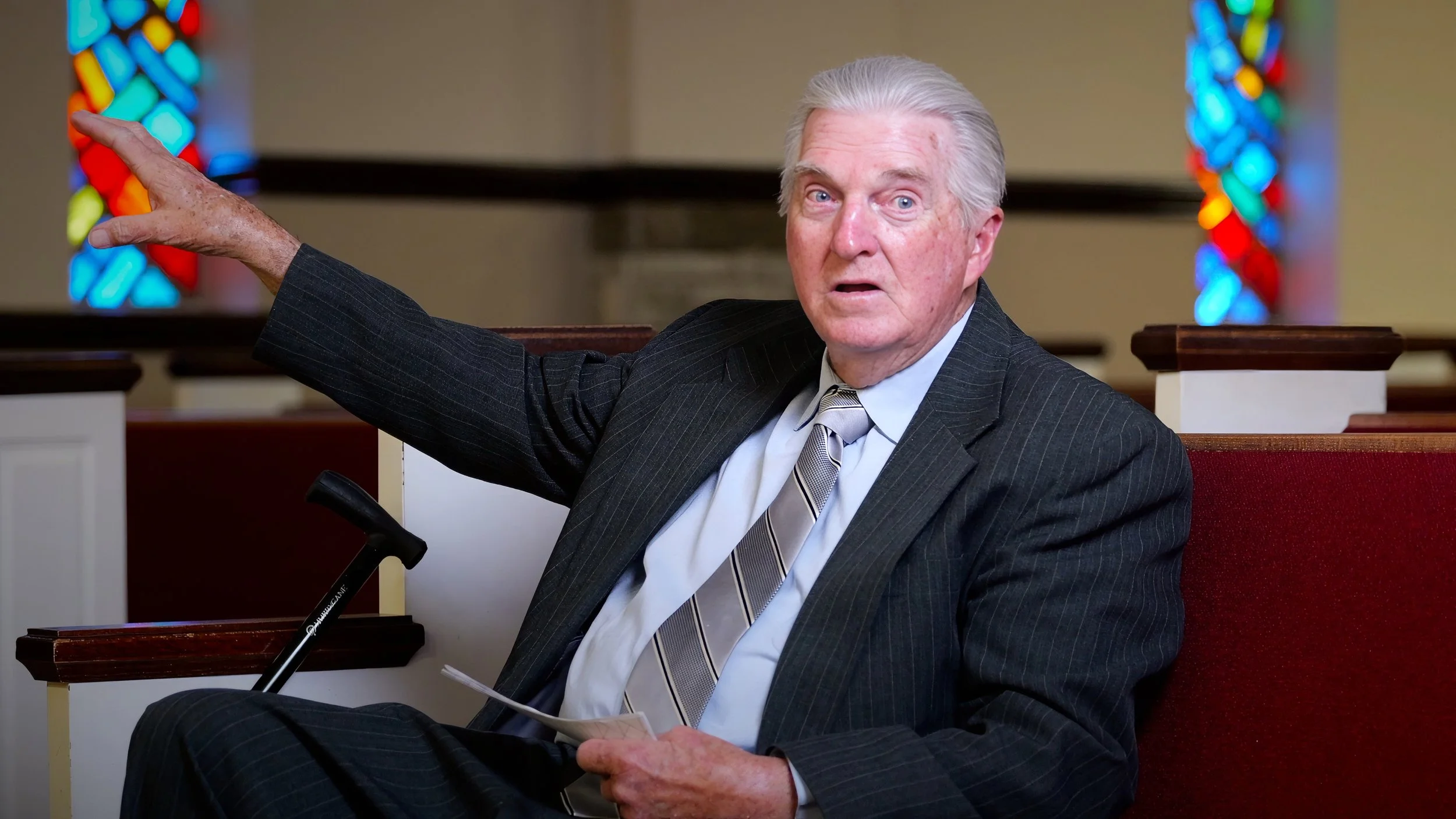
Arnold Wooten shares memories from 62 years of church membership. Interviews with longtime members helped preserve personal perspectives that might otherwise have been lost.
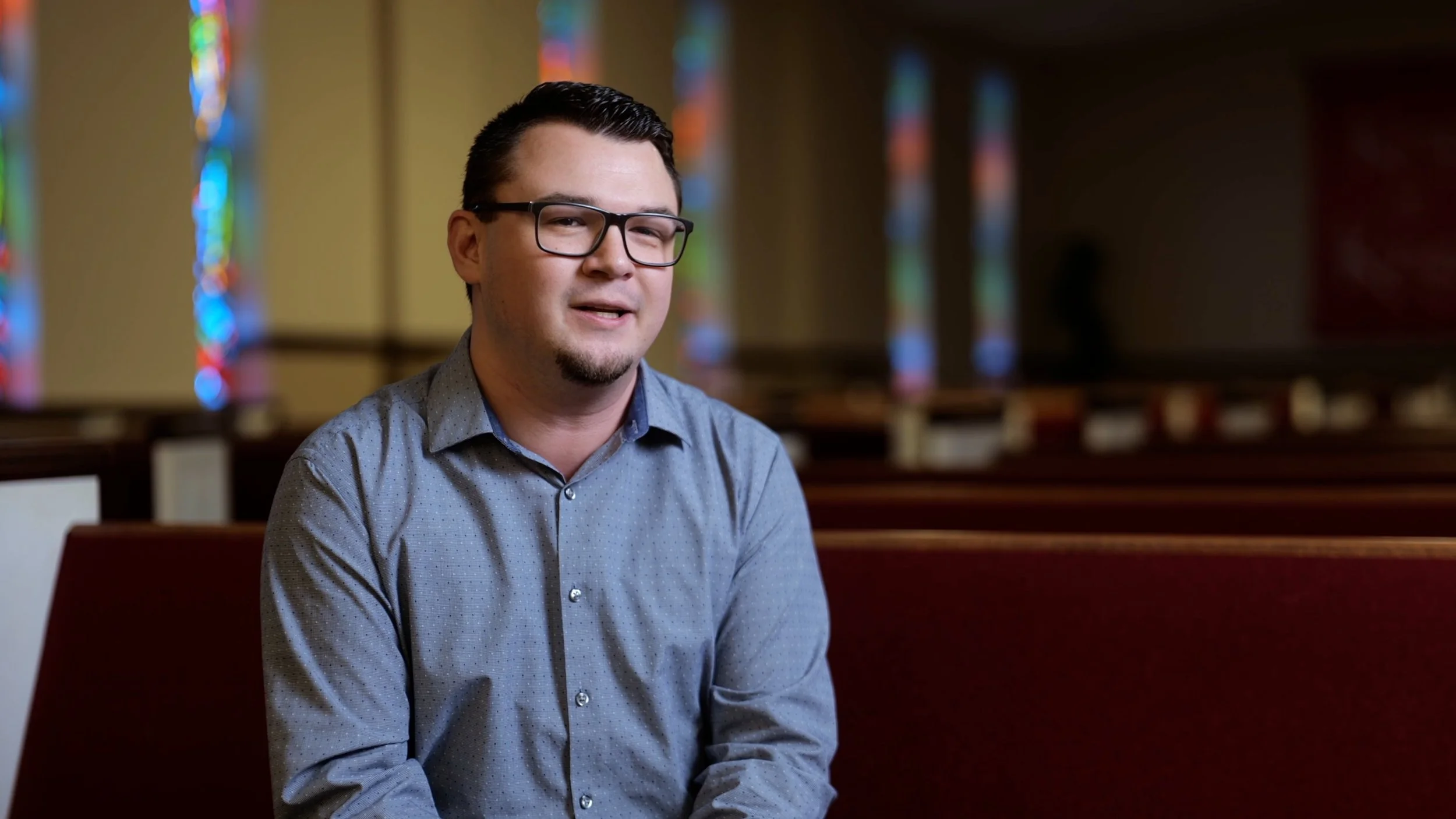
Pastor Adrian Franklin during a documentary interview inside the sanctuary. The church itself became an important part of the visual setting.
Lighting the Interviews: Lessons From a Career in Wedding Photography
Church sanctuaries can be beautiful environments for documentary interviews, but they also present significant technical challenges. At South Gastonia, I wanted to incorporate the stained-glass windows into the compositions because they were more than decorative backgrounds. They helped establish a sense of place, connecting each person to the environment where so many of their memories had unfolded. The challenge was balancing the bright light passing through the stained glass with the much darker interior of the sanctuary. Without carefully controlling that relationship, the windows could easily become overexposed while the people seated in front of them remained poorly illuminated.
My background in professional photography has shaped the way I approach cinematography, particularly when working with people in challenging environments where the quality and direction of light can transform an image. I have spent much of my career photographing people in churches, ballrooms, and other environments where beautiful architectural light and difficult exposure conditions exist in the same frame. For these interviews, I carefully controlled the strength and direction of my key light, bringing the subjects into balance with the stained-glass windows behind them. I wanted the windows to retain their color and detail while giving each person's face natural skin tones, dimension, and a flattering quality of light. By introducing enough controlled illumination to overcome the less desirable qualities of the existing light, I could shape the portraits without sacrificing the atmosphere of the sanctuary.
These decisions may go unnoticed by someone watching the finished documentary, and that is perfectly fine with me. The lighting should never become the subject of the film. It should create an atmosphere in which the people feel present, comfortable, and visually connected to the place where their stories unfolded. What appears effortless on screen is often the result of experience, technical knowledge, and a series of deliberate choices made before the interview begins.
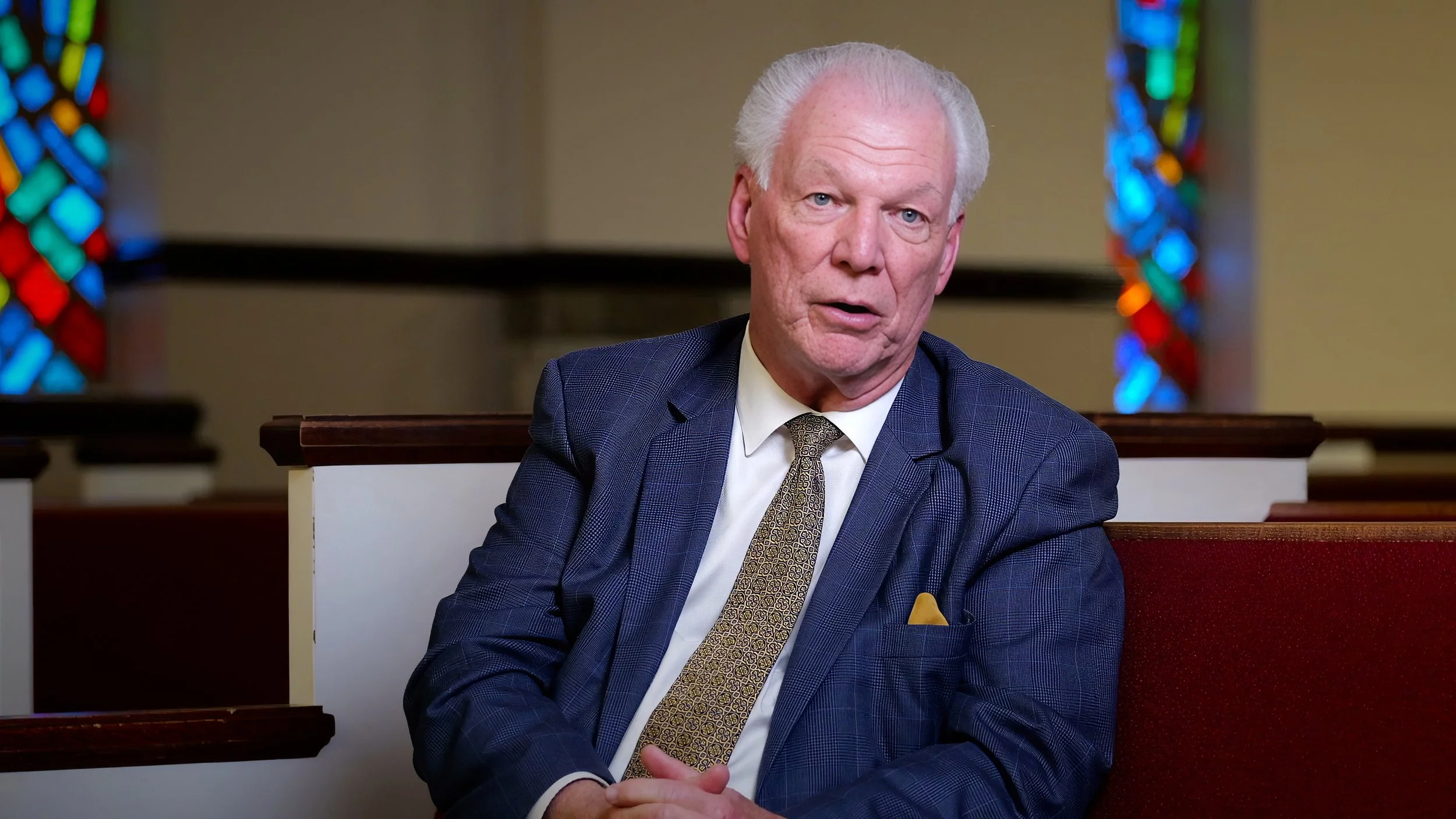
Professional interview lighting allowed me to shape natural skin tones while retaining the atmosphere and architectural character of the church.
Protecting the Voices We Cannot Afford to Lose
Beautiful cinematography is only one part of a successful documentary interview. The audio is every bit as important, and in many ways, the greater responsibility lies in ensuring that every word is recorded reliably. For the South Gastonia interviews, I positioned a boom microphone overhead to capture natural, detailed dialogue while simultaneously recording a separate lavalier microphone worn by each subject. This redundancy was intentional because documentary interviews are not always moments that can be recreated. When someone is sharing personal memories, particularly those of longtime church members whose experiences may reach back decades, there is no guarantee that another recording session can be arranged. People have schedules, personal circumstances, and limitations that may make returning for a second interview difficult or impossible.
Even if another interview could be scheduled, there is no guarantee that the same spontaneous moments would happen again. A technical failure could mean losing a memory, an expression, or a deeply personal reflection that simply cannot be recreated. I approach documentary production with that responsibility in mind. Professional sound recording is not merely about making dialogue sound good. It is about protecting the integrity of the story and respecting the time and trust of the people who have agreed to share it. A beautifully photographed interview has little value if the words are lost to a recording failure, and the same care that goes into preparing questions, shaping light, and composing an image must extend to safeguarding the material we have been entrusted to capture.
The Hours Behind a Few Seconds of Historical Footage
One of the most labor-intensive aspects of historical documentary production happens long before the archival photographs and recordings appear in the finished film. Older photographs must often be carefully digitized at a resolution suitable for professional presentation, and depending on their condition, they may require extensive attention to fading, dust, scratches, physical damage, contrast, and tonal inconsistencies. Digital restoration can be painstaking work. A single photograph may contain dozens of small imperfections, and repairing them requires judgment about what should be corrected and what should remain part of the original image's character. The goal is not to erase the age of a photograph or make it appear artificially modern, but to preserve its historical integrity while allowing the people and details within it to be seen clearly.
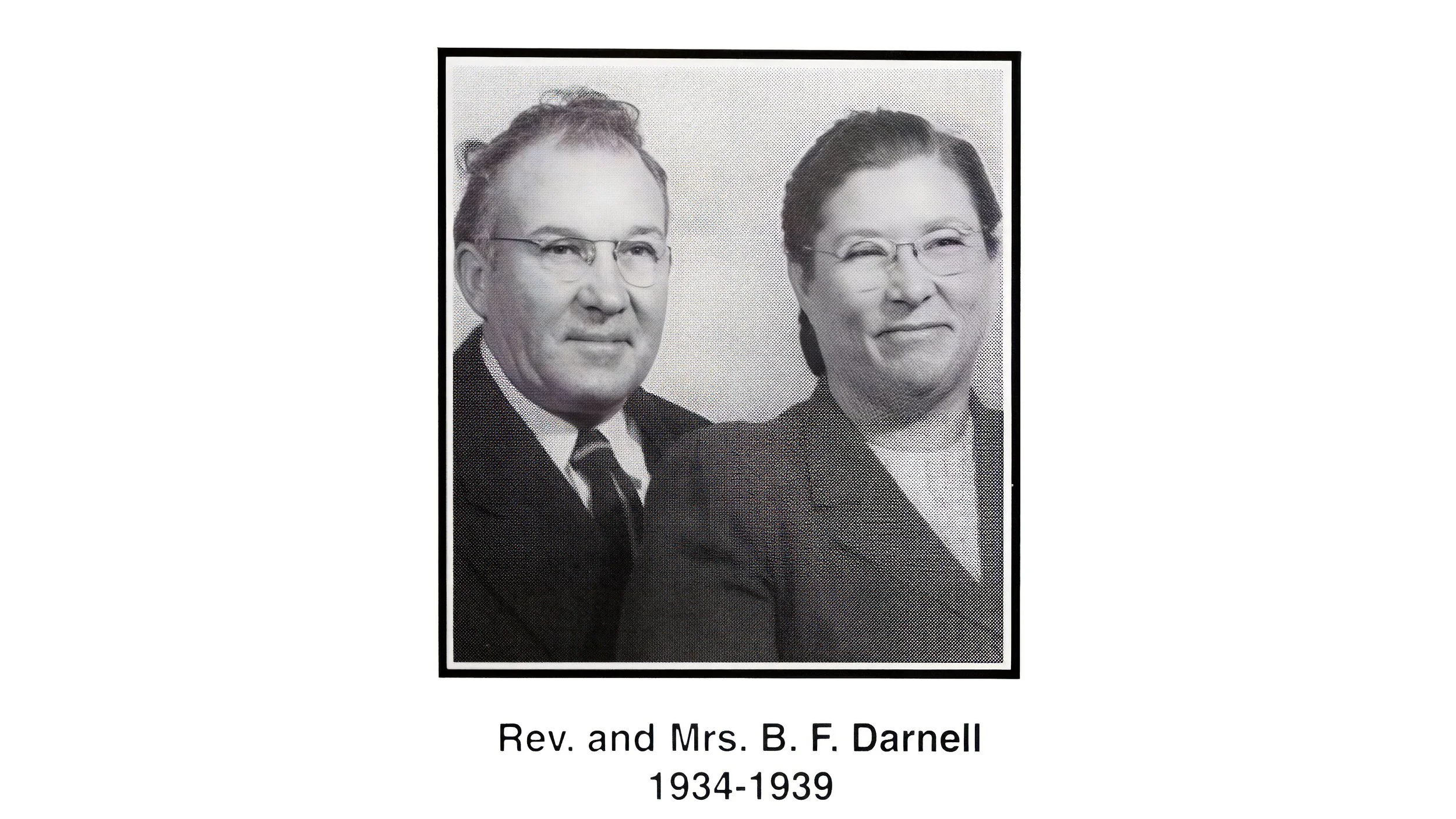
Rev. and Mrs. B. F. Darnell, 1934–1939. Historical portraits helped establish the people and leadership behind the church's early years.
Historical video recordings present another set of challenges. Older footage may need to be transferred from aging media, evaluated for picture and sound quality, and prepared for use alongside contemporary digital cinematography. Different recording formats, image dimensions, frame rates, and audio characteristics must all be considered. Some footage may benefit from careful digital cleanup, while other material is best presented with its original visual character intact. There is also the practical challenge of organizing and reviewing everything once it has been digitized. A collection of photographs and recordings may contain valuable historical moments, but discovering those moments requires time, patience, and an understanding of how they might contribute to the finished documentary.
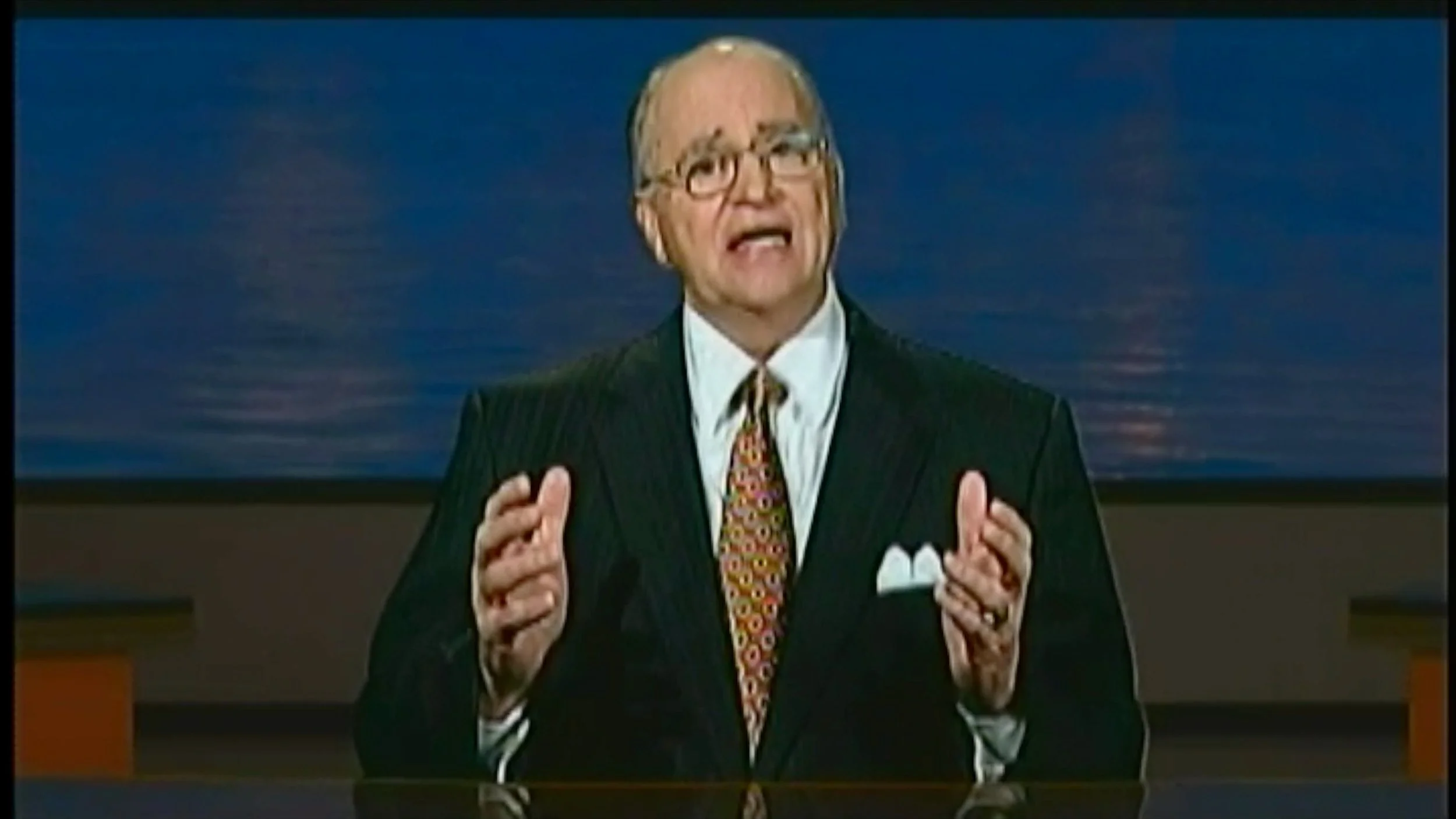
Historical video footage became another important part of the documentary's visual record. Preparing older recordings for contemporary film production requires care and technical attention.
The time involved in digitizing, organizing, restoring, and preparing archival materials can be substantial. What an audience sees for only a few seconds may represent hours of work behind the scenes, yet I consider this effort essential. These photographs and recordings are often irreplaceable, and preparing them properly is both a technical responsibility and an opportunity to preserve something meaningful for future generations. Beyond their contribution to the finished documentary, bringing historical materials into a digital environment can help ensure that important visual records remain accessible long after the original prints or recording formats have deteriorated.
Giving Historical Images a New Life
Once archival photographs have been digitized and prepared, another creative process begins. I have to decide how each image will function within the story and how it can contribute to the emotional rhythm of the film. Should a photograph remain completely still, allowing viewers time to study the faces? Would a subtle movement help guide attention toward an important detail? Does the image belong alongside a particular interview, or does it communicate something more powerful when paired with a different memory? These decisions may seem small, but they influence how an audience experiences the relationship between the past and the present.
One of the historical photographs, seen below, depicted an earlier congregation gathered for worship. Looking at the raised hands and expressions, I was reminded that these were not simply records of past events. They were photographs of people experiencing moments that mattered deeply to them. My goal was to make these historical images feel connected to the living voices in the film without changing their meaning or presenting them as something they were not. Photography has always been about more than recording appearances for me. It is about recognizing moments that reveal something human, and working with historical photographs calls upon that same instinct.
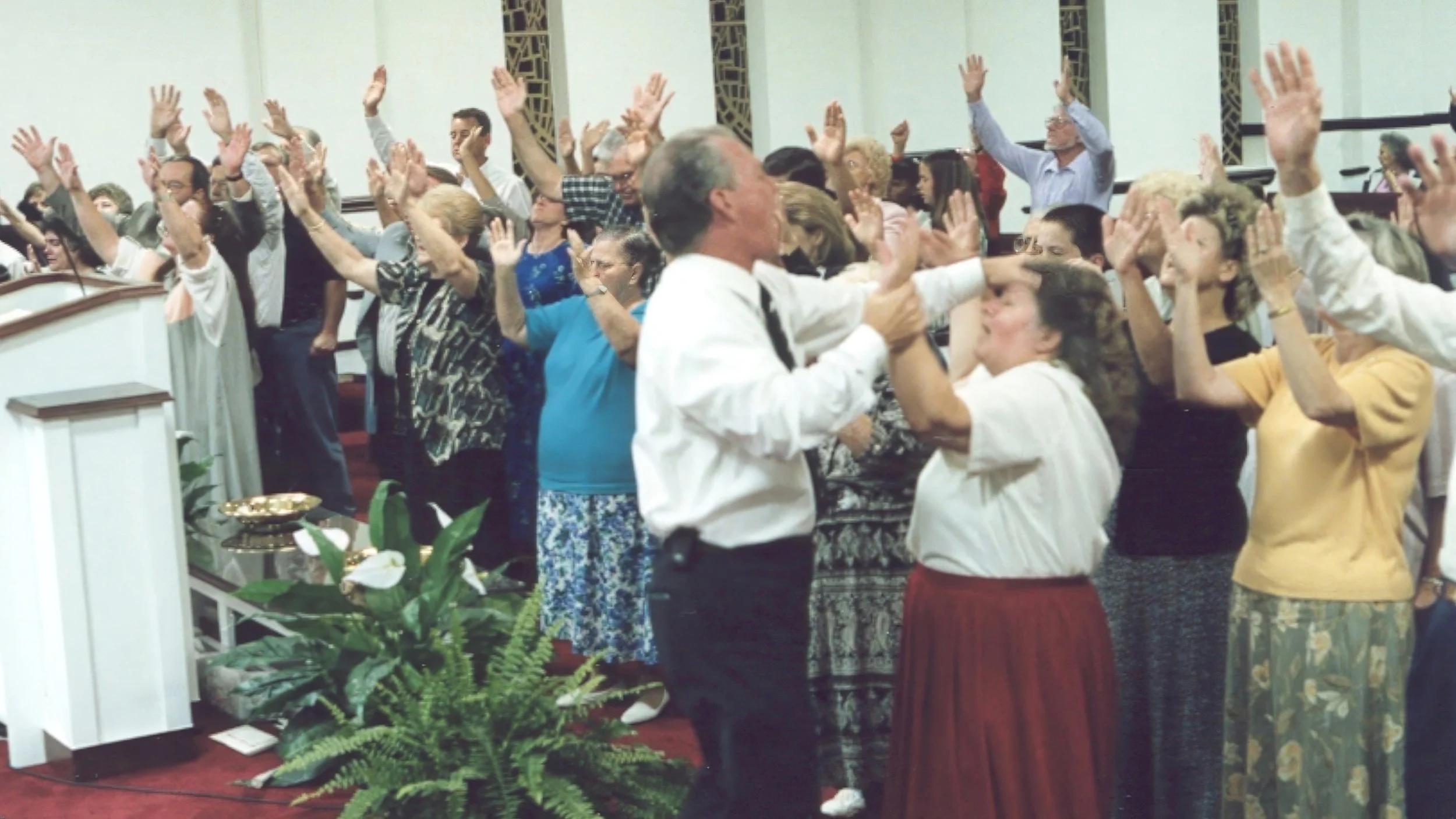
A historical worship service at South Gastonia Church of God. Archival photographs help preserve not only the appearance of a place but also the experiences of the people who gathered there.
Reimagining an Outdoor Revival Through Art and Technology
Some parts of the church's history presented a different challenge. There were stories worth illustrating, but no surviving motion-picture footage showing those particular moments. One example involved early outdoor revival meetings held beneath an arbor, a simple open-air structure where people gathered for worship. I began with an authentic black-and-white photograph of a preacher from that historical period and explored how generative AI could help me reimagine his likeness within an outdoor revival setting. The intention was to create a visual interpretation that would help contemporary audiences imagine an important chapter of the church's early history while maintaining a connection to an actual person from that era.
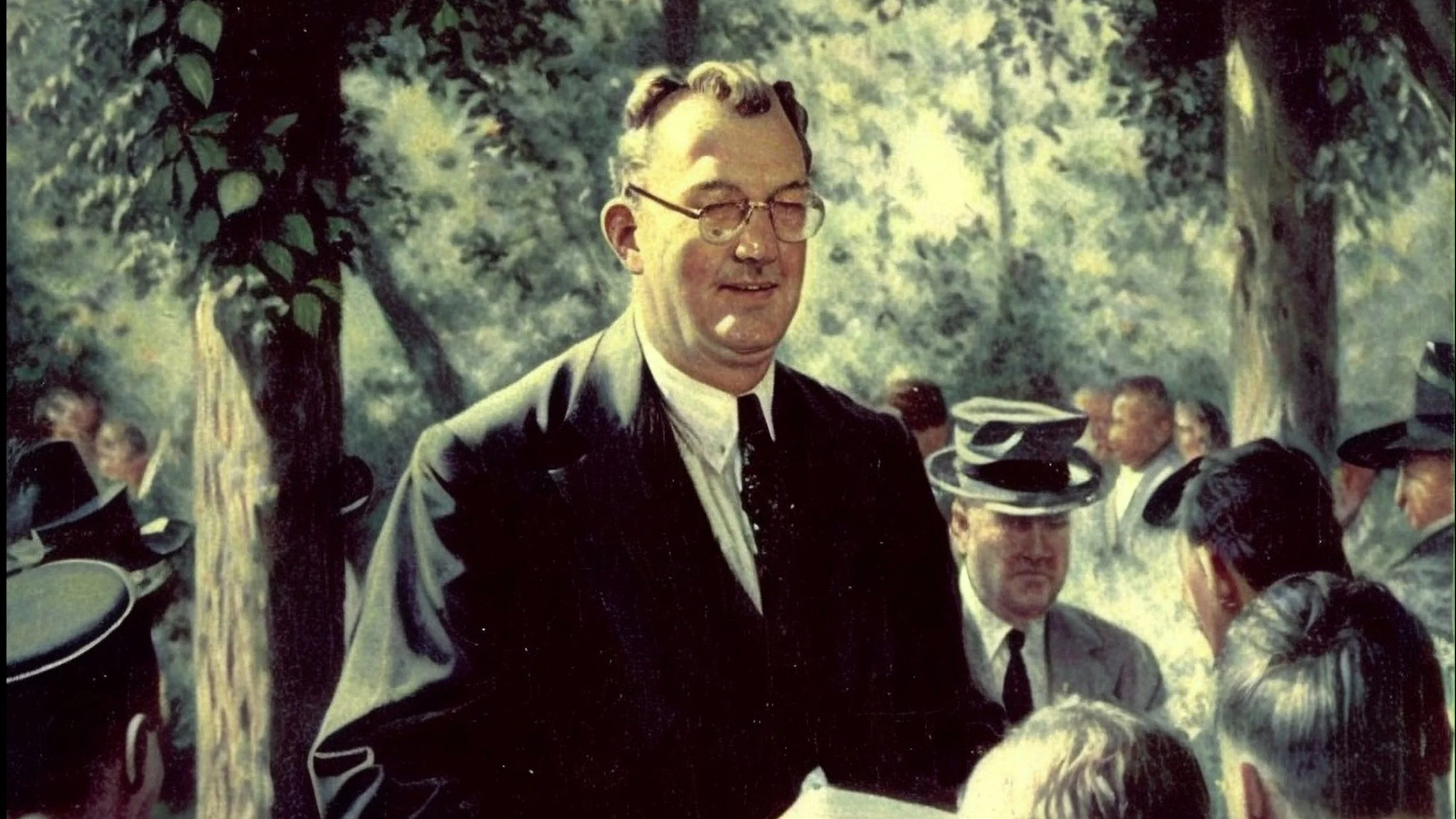
An AI-assisted historical reconstruction created from an authentic photograph of a preacher. The imagined outdoor revival setting illustrates the church's early history and is not presented as an original historical photograph.
The resulting image was an artistic reconstruction rather than an authentic historical photograph of the depicted gathering, and I think that distinction is important. For me, emerging technology becomes most interesting when it helps communicate something meaningful. The original photograph provided a connection to a real person, while the reconstruction offered a way to visualize a setting that could not otherwise be shown. The technology did not eliminate the need for artistic judgment. I still had to consider historical context, composition, lighting, atmosphere, and whether the image genuinely served the story. Generative AI can offer possibilities, but it cannot determine which possibilities are meaningful. That remains the responsibility of the filmmaker, and it is the same principle that guides my work whether I am using a camera, a paintbrush, traditional editing tools, or emerging technology.
This relationship between emerging technology and human judgment is also central to my Human First keynote, where I explore why creativity, discernment, and emotional understanding become even more important as our technological possibilities expand.
Creating a Visual Identity for the Anniversary
The commemorative 90th anniversary identity I designed for the film, bringing a consistent visual language to the historical documentary.
In addition to the documentary cinematography and historical materials, I developed a commemorative visual identity for the church's 90th anniversary. The design incorporated the church's name, its founding year of 1933, architectural imagery, and the anniversary milestone. I wanted the graphic to feel appropriate to the occasion while providing a visual connection between the church's historical foundations and the contemporary film. This became part of the documentary's presentation, helping establish a consistent visual language throughout the production. The design also appeared on T-shirts and memorabilia created for the church’s milestone celebration.
I enjoy this aspect of filmmaking because it draws upon my experience in graphic design, photography, filmmaking, and visual art. A documentary is more than a collection of interviews and photographs. Typography, graphic design, color, transitions, pacing, and sound all influence how an audience experiences the story. When these elements are thoughtfully integrated, they help create a finished film that feels cohesive rather than a series of unrelated historical materials. Ideally, the design supports the narrative so naturally that viewers experience it as part of the film rather than as a separate creative element.
The Most Difficult Creative Decision: What Gets Left Out
After the interviews have been recorded, the historical materials prepared, and the visual elements created, the documentary enters what I consider one of its most demanding stages. Editing. A documentary may begin with hours of interviews, hundreds of photographs, archival recordings, and a considerable amount of contemporary footage. There may be many fascinating stories, but not all of them belong in the finished film. This is where the director's judgment becomes especially important, because the challenge is no longer simply gathering meaningful material. It is determining which moments will communicate the larger story most effectively.
An interview may last an hour or more, yet only a few sentences might ultimately be included. Someone may share a wonderful memory that is meaningful to them personally, but it may not advance the larger narrative. A historical detail may be fascinating without being essential to understanding the congregation's story. Making these decisions requires sensitivity because people have generously shared their memories, and I never take that lightly. But including everything would not necessarily honor those stories. It could make the film less focused and diminish the impact of the moments that matter most. I have to consider what the audience needs to understand, what will help them connect emotionally, and what will remain meaningful years from now.
Sometimes the strongest editorial decision is to remove something I personally love. A beautifully photographed scene, an interesting historical fact, or a moving interview passage may have to be left behind because the film becomes stronger without it. This is also where my experience as a musician influences my filmmaking. I think about pacing, transitions, silence, and emotional movement much as I think about the arrangement of a song. A documentary needs moments of energy and moments of reflection. It needs room for people and their memories to breathe, and it needs a structure that allows the story to develop naturally without overwhelming the audience with information.
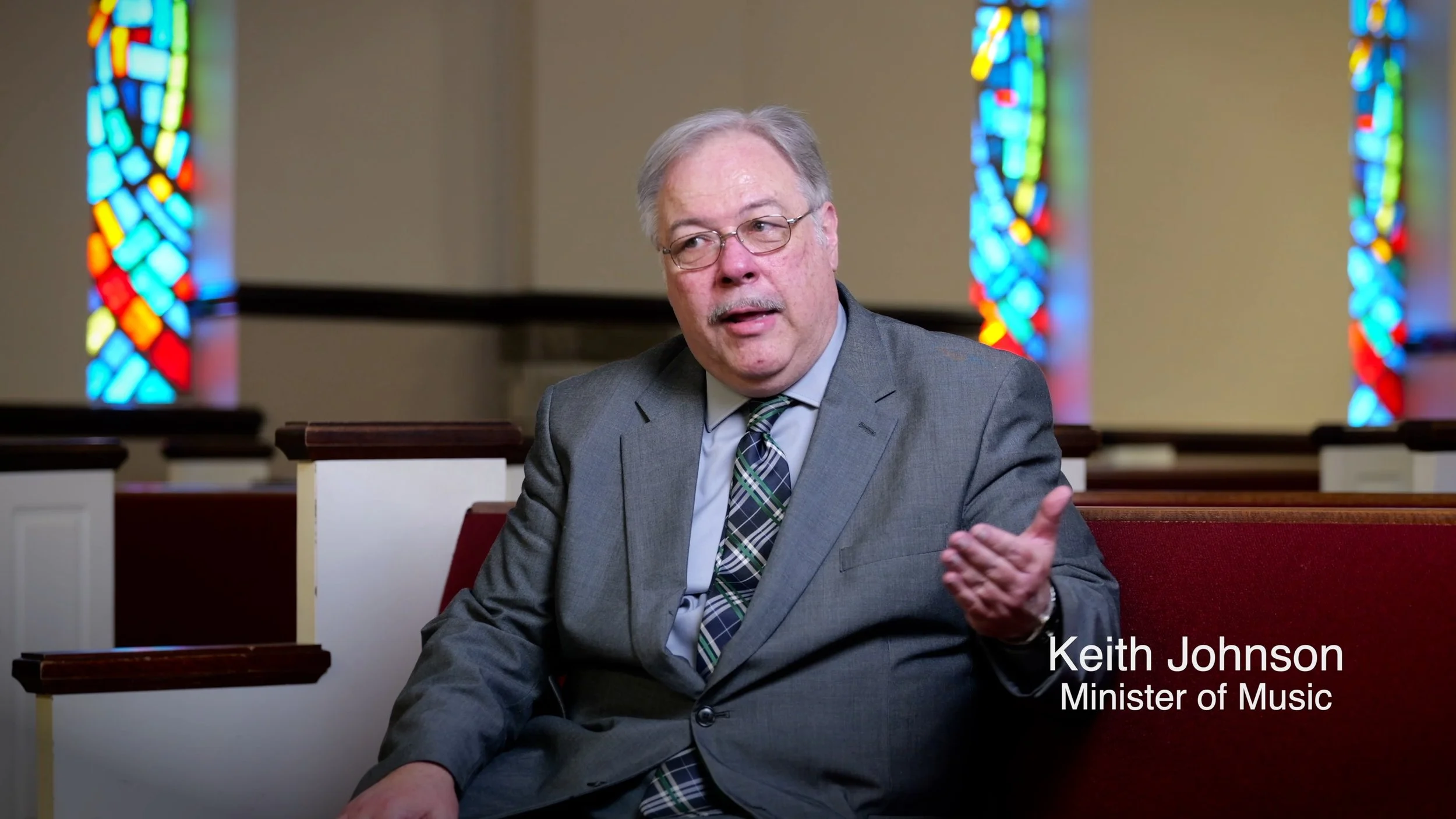
Keith Johnson, Minister of Music, was among the church leaders interviewed for the documentary. The finished film brings together different voices and perspectives into one narrative.
Ultimately, editing is not simply about shortening the material. It is about discovering the film within it. The questions I prepare, the conversations I pursue, the moments I recognize, and the material I choose to leave behind all shape the finished documentary. The camera captures what happens in front of it, but the filmmaker must decide what it means.
Watch the South Gastonia Church of God 90th Anniversary Documentary
South Gastonia Church of God | 90th Anniversary Documentary
Ninety years of faith, community, and generations of shared history come together in this documentary celebrating South Gastonia Church of God in Gastonia, North Carolina.
Directed and produced by filmmaker Charles Maring, the film traces the church's history from its founding in 1933 through the personal memories of longtime members, pastors, and church leaders. Through intimate interviews, historical photographs, restored archival materials, and contemporary cinematography, the documentary brings the people and experiences behind nine decades of ministry to life.
The production combines carefully directed interviews, cinematic lighting within the church sanctuary, archival preservation, original graphics, and historical visual storytelling to create a lasting record of the congregation's journey.
More than a celebration of an anniversary, this film is a tribute to the individuals and families whose faith, dedication, and relationships shaped the church across generations, preserving their stories for those who will follow.
The finished film brings together personal interviews, contemporary cinematography, historical photographs, archival recordings, digital restoration, original graphics, and an AI-assisted historical reconstruction. Each element serves a larger purpose, helping the congregation experience its history not merely as a sequence of dates and events, but as a story shaped by people. For longtime members, I hope the film brings back memories of familiar faces, places, and experiences. For younger generations, I hope it offers an opportunity to discover the people whose lives helped shape the church they know today. And for those outside the congregation, I hope it communicates something universal about the importance of community, continuity, and the stories we inherit.
Why Church History Deserves to Be Preserved
Working on this documentary made me think about how many other stories are waiting to be told. Across the country, churches are approaching significant anniversaries. Some have histories stretching back a century or more, while others have played important roles in the development of their towns, neighborhoods, and communities. Many have collections of photographs, documents, recordings, and personal memories that have never been brought together into a comprehensive film. Beyond individual congregations, entire denominations have histories shaped by generations of ministers, missionaries, church leaders, and families. These stories may span multiple states, countries, and generations, intersecting with larger cultural and historical events that deserve to be understood and remembered.
Documenting that history requires more than technical proficiency. It requires research, careful listening, sensitivity to the people involved, an understanding of historical materials, and the ability to recognize which stories deserve to be carried forward. A thoughtfully produced documentary can become part of an organization's historical record, preserving the voices of people who may not be here decades from now and making those voices available to generations who never had the opportunity to know them. It can also bring people together around a shared understanding of where they came from and what their community has meant to those who helped build it. That is a responsibility I find deeply meaningful, and it is one of the reasons historical documentary filmmaking has become such an interesting extension of my creative work.
The Stories We Leave Behind
I have spent much of my career photographing people, making films, composing music, and creating visual art. Although these disciplines may appear different, they are connected by a common interest in human experience. I am interested in the moments that reveal something about who we are, what we value, and how our lives connect with others. The South Gastonia Church of God documentary reminded me that some of the most meaningful stories are not about extraordinary public achievements. They are about ordinary people whose faith, perseverance, relationships, and commitment helped build something that would outlast them. The importance of preserving personal stories also connects with themes I explore in Still Becoming, a keynote about identity, change, resilience, and the ways our experiences shape what comes next.
A photograph can preserve a face. A recording can preserve a voice. A documentary has the opportunity to bring those fragments together and help us understand the lives behind them. Ninety years is a remarkable milestone, but what moved me most about this project was not the number itself. It was the realization that every one of those years represented people, experiences, and memories that contributed to a living community. Somewhere within those photographs, recordings, and conversations are stories that future generations deserve to know. Bringing those stories together requires patience, curiosity, technical skill, and a willingness to make difficult creative decisions, but the result can become something far more enduring than a film created for a single celebration.
That is why I believe this work matters.
For churches and organizations considering how to preserve their own history, my production company, Maring Visuals, creates professionally directed documentary films that bring generations of stories to life. You can explore our approach to church history and anniversary documentary filmmaking, including the process of preserving personal memories, historical photographs, and archival footage for future generations.
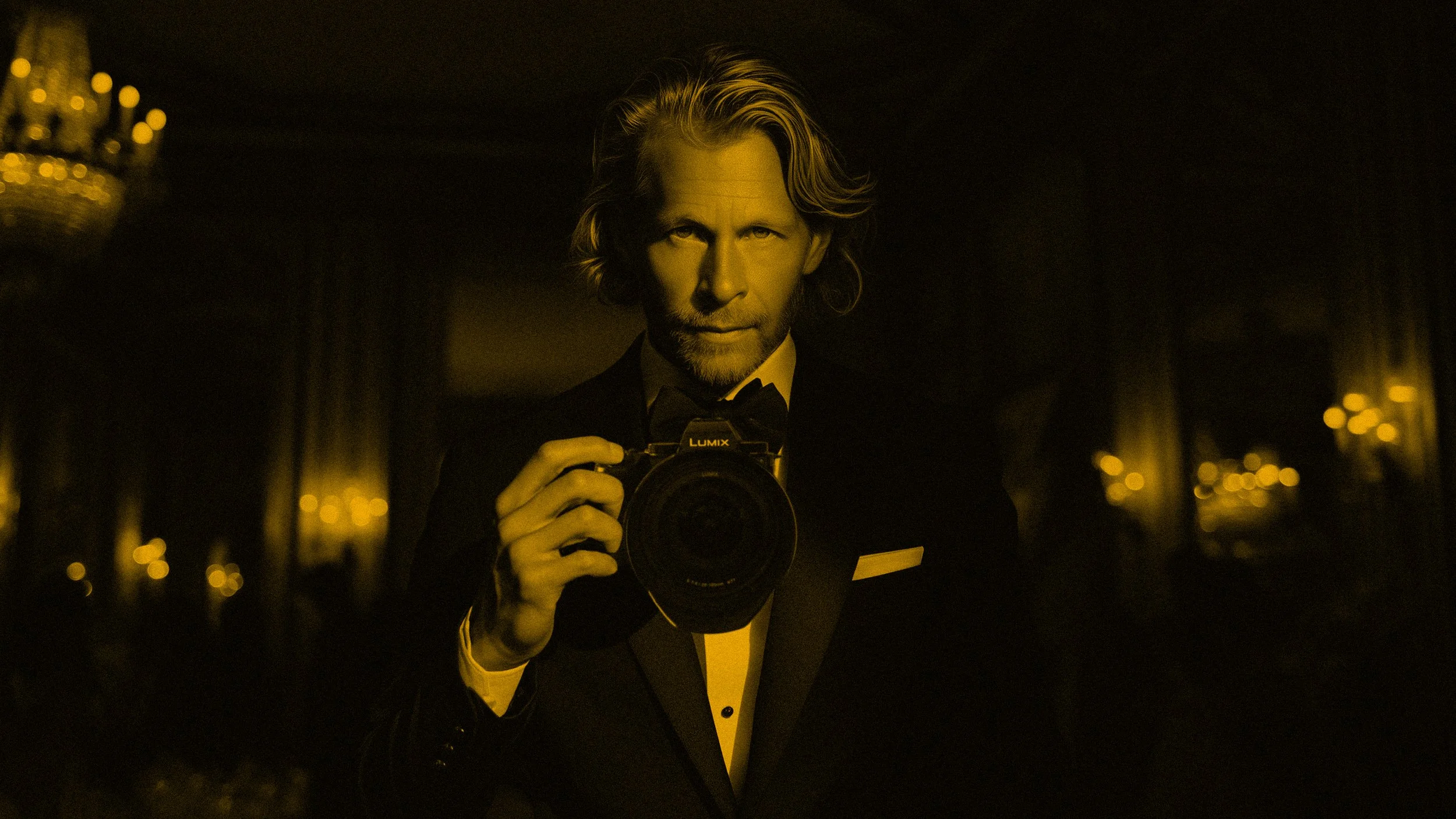
Charles Maring is an artist, photographer, filmmaker, musician, and creative director whose work brings together visual storytelling, cinematography, and human experience. Explore more of his creative direction and filmmaking.