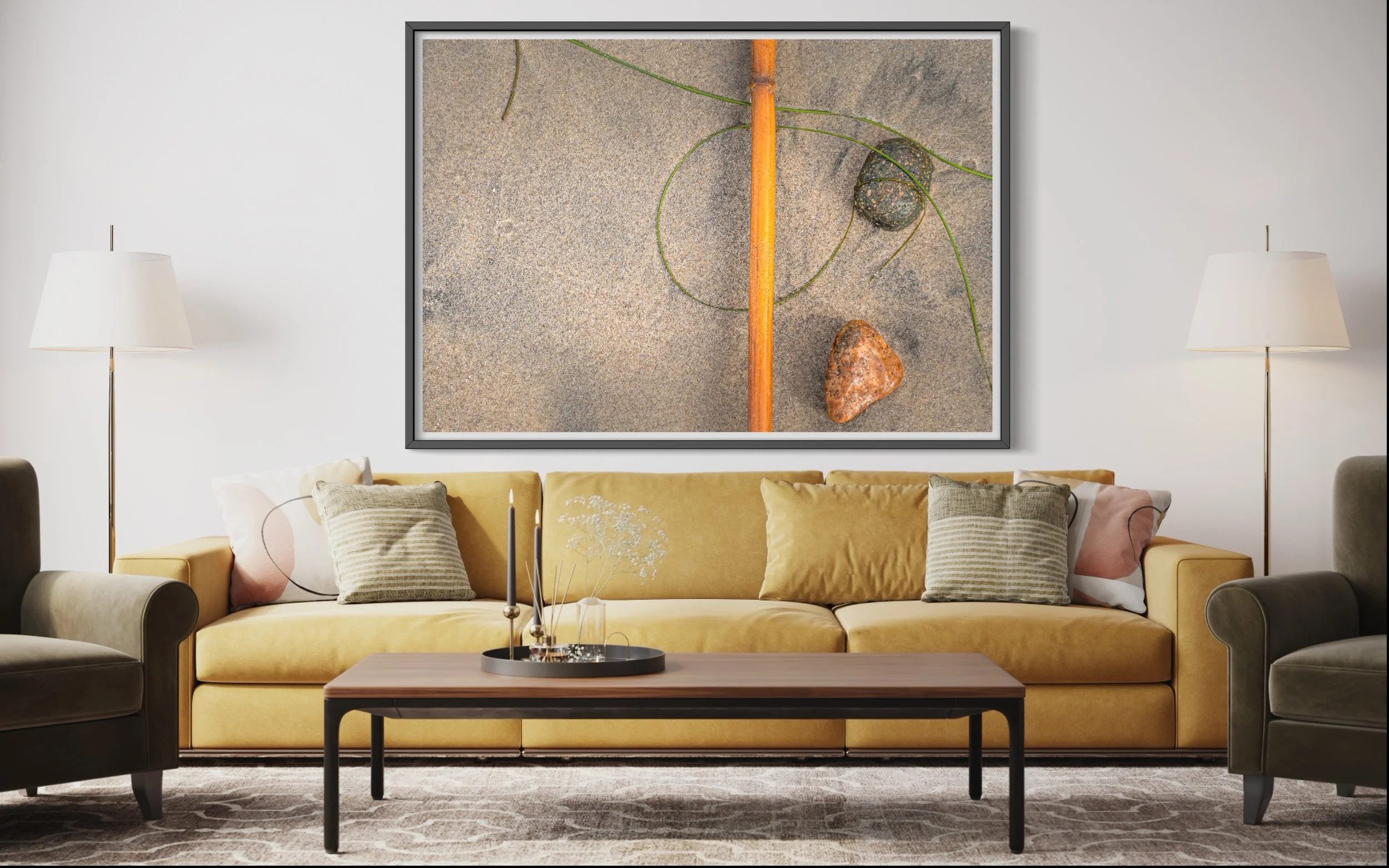
A Song Left Behind, from The Rocks of Oceanside. A fleeting arrangement of driftwood, stones, and seaweed becomes a study of movement, balance, and the art of noticing.
A Song Left Behind: The Fleeting Art of the Shoreline
Some of the most fascinating works of art I've encountered were never intended to last. They appeared along the shoreline, shaped by the movement of water, sand, stones, and seaweed, only to disappear when the next tide arrived. Over the years, I've spent countless hours exploring beaches with my camera, studying the unexpected compositions that nature leaves behind. What began as an interest in the abstract beauty of the shoreline gradually became a deeper exploration of imagination, composition, and the extraordinary things we might discover when we pay closer attention to the world around us.
One photograph from my collection The Rocks of Oceanside, titled A Song Left Behind, captures much of what fascinates me about this process. A small arrangement of stones, driftwood, and seaweed creates a composition that feels almost deliberately drawn. The delicate curves of the seaweed introduce movement, while the vertical form of the driftwood establishes structure within the frame. The surrounding sand provides a quiet background that allows these relationships to emerge. Nothing about the individual elements is particularly extraordinary, yet together they create something I find visually compelling. The arrangement was temporary, shaped by the ocean and destined to disappear. Photography gave me an opportunity to recognize that moment, interpret it, and preserve it as a work of art.
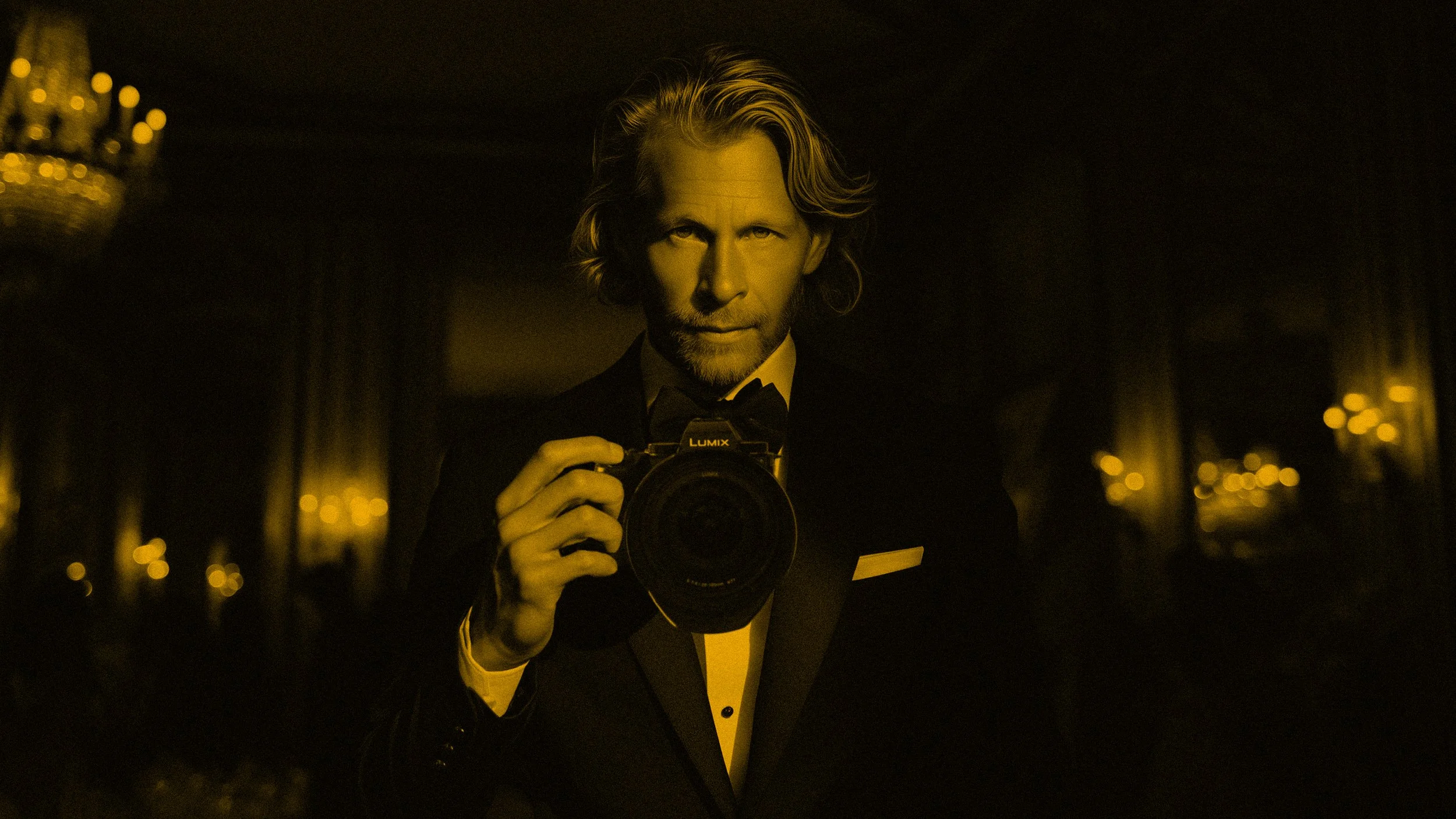
A glimpse behind The Rocks of Oceanside, a fine art photography study by Charles Maring exploring fleeting compositions of stones, sand, shadows, and water, and the artistic vision that transforms them into lasting photographs.
When Nature Creates Characters
One of the more intriguing aspects of these shoreline studies is the way recognizable characters sometimes emerge from seemingly random arrangements. A small stone can suggest the face of a bird, a rabbit, or an imaginary creature, while the darker patterns surrounding it provide the suggestion of a body, wings, ears, or movement. These impressions are not created by the stones alone. They emerge through the relationships between the objects and the patterns left behind by retreating water. Dark mineral deposits, wet sand, and subtle changes in texture can become as important as the rocks themselves, creating forms that seem almost intentional.
I find this fascinating because our imaginations naturally search for recognizable shapes and relationships. A composition that reminds me of a bird might suggest something entirely different to another person. I enjoy that ambiguity. It allows the photograph to become a conversation between what nature created, what I recognized, and what someone else discovers while looking at the finished image. Not every photograph needs to resemble a character, however. Some of the simplest arrangements catch my attention because of their balance, their quiet elegance, or an unexpected relationship between light and shadow. The recognizable subject may provide the initial intrigue, but it isn't necessarily what makes the photograph successful.
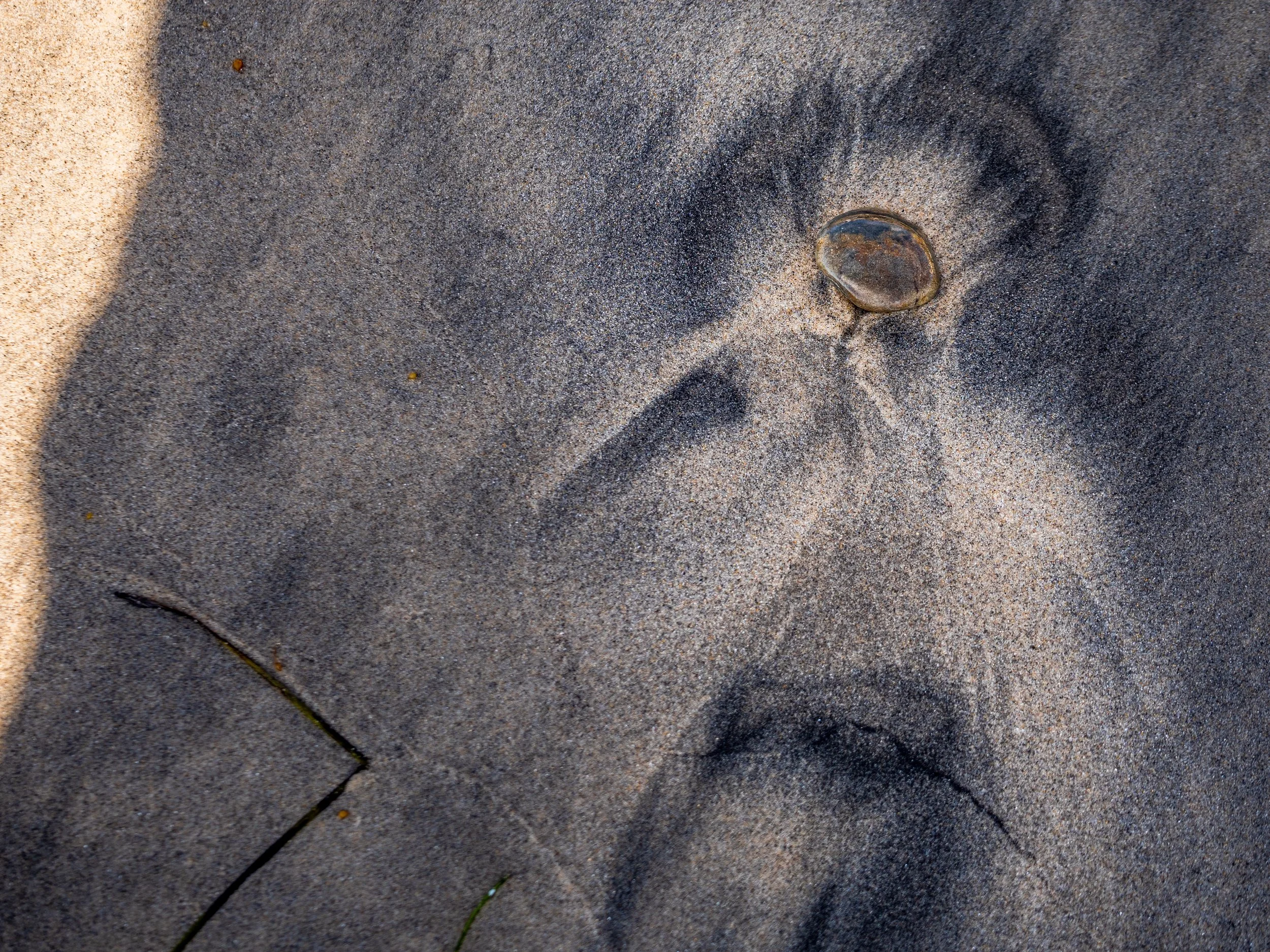
A bird-like figure emerges through the relationship between a stone, darker sand patterns, and contrasting tones. From The Rocks of Oceanside.
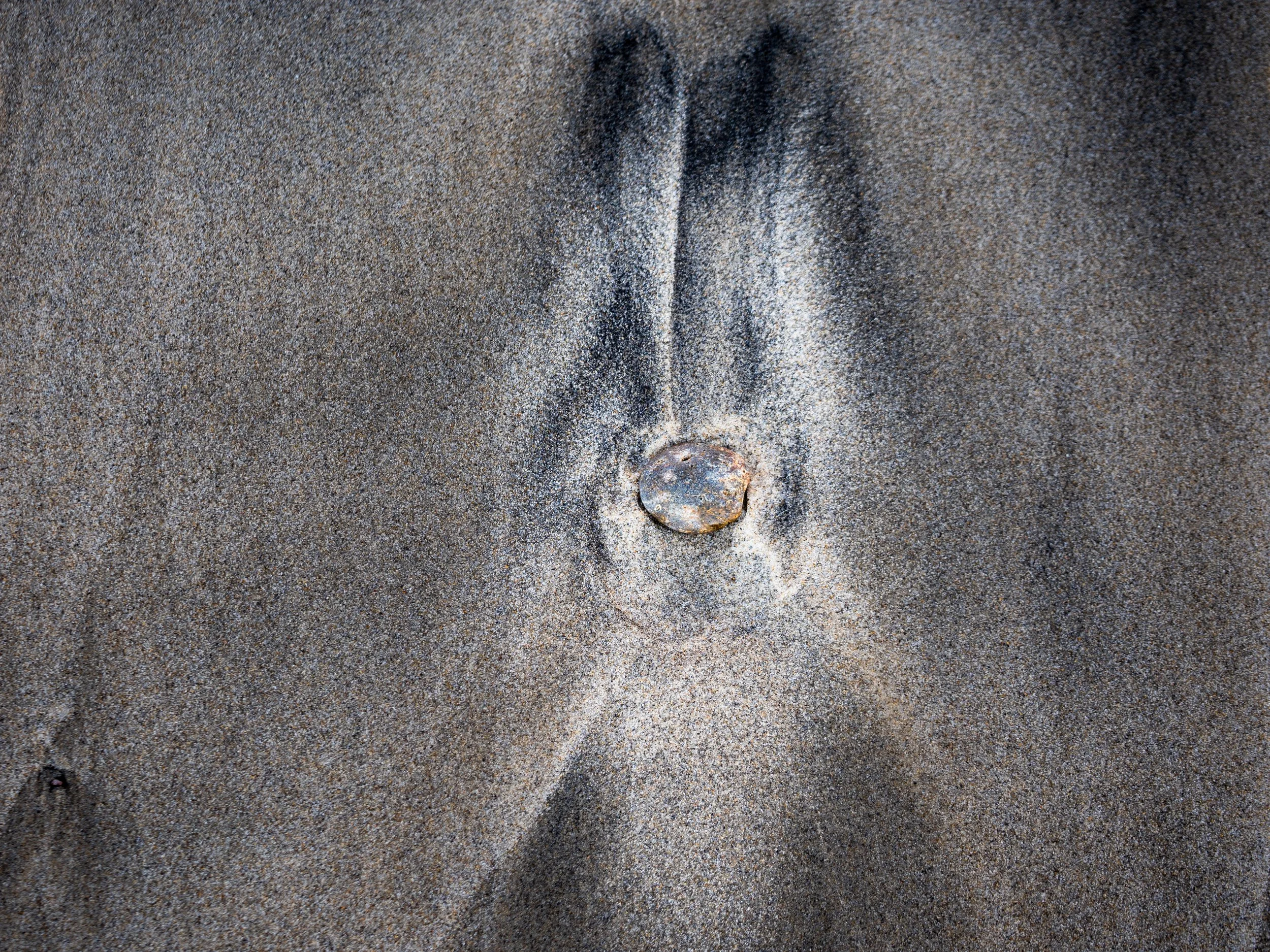
A fleeting arrangement of stone and sand suggests a rabbit, inviting the viewer's imagination to complete the character.
Composition Is More Than Subject Matter
Throughout my career as a photographer, I've come to appreciate that compositional balance can be every bit as important as the subject itself, and sometimes more important. A photograph might contain something fascinating, but without thoughtful framing, the visual relationships that give it meaning can easily be lost. Along the shoreline, I find myself studying the direction of lines, the weight of darker shapes, the distribution of negative space, and the subtle ways different elements interact. A slight change in camera position can dramatically alter the composition. Moving closer might strengthen a relationship between two stones, while stepping back could reveal that a surrounding shadow is actually the most important element in the frame.
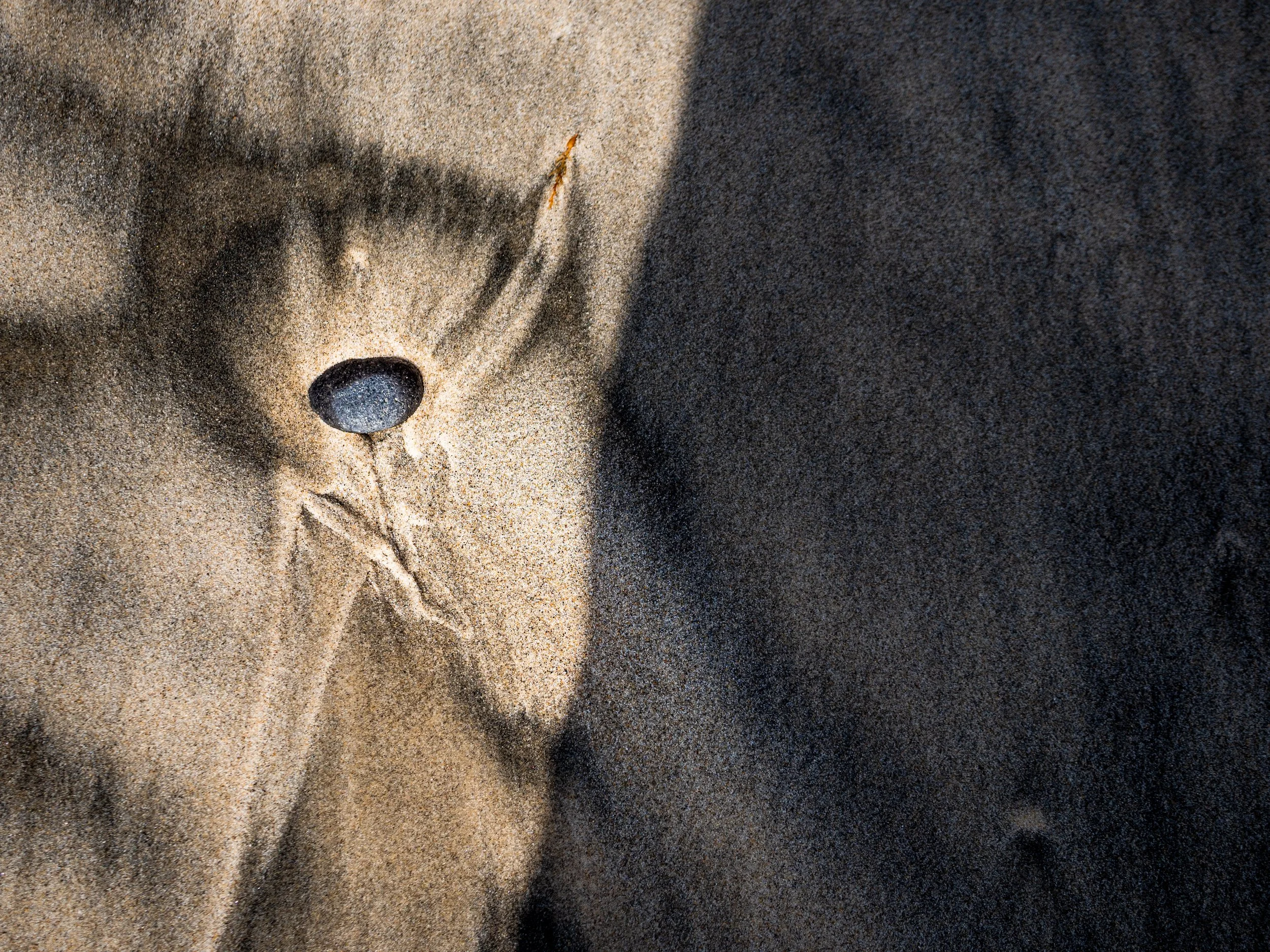
Here, the relationship between shadow, negative space, and a small stone becomes more important than the subject itself. From The Rocks of Oceanside.
Color also plays a significant role. In some of these photographs, cooler tones create a dramatic contrast against warmer areas of sand, giving otherwise simple forms an unexpected intensity. In others, shadows introduce large areas of darkness that balance a relatively small subject. These decisions about framing and perspective are fundamental to my artistic process. I'm not simply looking for interesting objects to photograph. I'm searching for relationships between shapes, textures, light, and space that create a compelling visual experience. The ocean may have arranged the elements, but the photograph becomes my interpretation of what I discovered.
Beyond Documentation: The Artist's Interpretation
Discovering an interesting composition is only the beginning of making a photograph. What follows involves a series of creative decisions that influence how the viewer ultimately experiences the image. Camera settings determine how light, detail, movement, and tonal relationships are recorded, and those decisions can help emphasize the qualities that first attracted my attention. One composition might benefit from stronger contrast or a more dramatic relationship between highlights and shadows, while another may depend on subtle tonal transitions and delicate textures. There is no single approach that works for every subject because every photograph presents a different visual opportunity.
The creative process continues when I develop the photographs. I make individual decisions about contrast, color, texture, and tonal relationships, considering how each adjustment contributes to the visual message. Sometimes deeper shadows strengthen a composition, while other images become more compelling through restraint. My objective isn't simply to reproduce exactly what someone else might have seen standing beside me. It's to communicate what I recognized, what I found compelling, and why I chose to preserve that particular moment. This distinction is central to my approach to fine art photography. The camera records information, but artistic judgment transforms that information into an interpretation. For me, the finished photograph is much more than documentation.
Every Shoreline Has Its Own Personality
I've explored these kinds of natural compositions along beaches in New England, on Tybee Island, in Oceanside, and in other coastal environments. Every shoreline has its own character, influenced by the texture and color of the sand, the stones and shells that collect there, the movement of the water, and the changing conditions of light and tide. Some beaches reveal delicate, almost minimalist arrangements, while others produce dramatic contrasts, intricate patterns, and unexpected forms. Even returning to the same beach can offer an entirely different experience because the conditions are constantly changing.
That variety is one of the reasons I continue returning to the shoreline with a camera. I never know precisely what I'll discover, and I don't believe every outing needs to produce an extraordinary photograph. Sometimes the experience is simply about looking, exploring, and remaining curious. Other times, something remarkable appears in the most ordinary place, and I recognize a composition that deserves closer attention. The practice has taught me that inspiration isn't always something we need to manufacture. Sometimes it is already present, waiting for us to notice it.
Preserving What the Tide Will Take Away
Perhaps the most meaningful aspect of these photographs is their impermanence. Unlike a landscape that may remain recognizable for generations, the small compositions created by a retreating tide can exist for only a brief period. A wave shifts a stone, carries away a strand of seaweed, or changes the patterns in the sand, and the arrangement that caught my attention is gone. There is no guarantee that the same combination of elements will ever appear again. That fleeting quality adds something important to the experience of making the photograph. It encourages me to remain attentive, to trust my instincts, and to recognize that sometimes the opportunity to create something meaningful exists only in the present moment.
I think that is part of what makes photography such a remarkable artistic medium. It allows us to preserve moments that would otherwise disappear, but the value of the finished image comes from more than the fact that the moment existed. It comes from the photographer's ability to recognize its possibilities and interpret them through composition, light, technique, and personal vision. With A Song Left Behind and the larger Rocks of Oceanside collection, I hope viewers discover not only the beauty of these temporary arrangements but also the pleasure of looking more closely at the world around them.
Living With the Art of Nature
When one of these photographs becomes a finished fine art print, something interesting happens. An arrangement that may have existed for only a few moments along the shoreline becomes a lasting presence within a home or collection. The scale of the print invites viewers to explore details that might have gone unnoticed in the original setting, while the composition takes on a life beyond the beach where it was discovered. I enjoy that transformation because it allows something fleeting to become a continuing source of curiosity, imagination, and visual discovery.
A Song Left Behind is one of the works through which I explore this relationship between nature and artistic interpretation. You can discover more of my fine art photography or explore available artwork. Collectors interested in experiencing my work in person are also welcome to inquire about a private viewing at my art loft in downtown Savannah.
The ocean doesn't preserve its compositions. It creates them, changes them, and eventually takes them away. My photographs are a record of the moments when I happened to be there to notice, and of the artistic choices that allowed me to share what I saw.